Showing posts with label Outside. Show all posts

Thursday, January 3, 2013

Not As Different As I Thought (Part I)

by Susan Milton, Clearwater parent

One day a couple of years ago, I was at a playground chatting about schools with another mom while our kids played. After hearing a bit about The Clearwater School, where my kids go, and The Bryn Mawr School for Girls, where I went as a child, she said, "Oh, so you wanted your kids to have the kind of school that you had". I started to say, "oh, no, no,...", when all of the sudden I realized that she had a point. In mid-sentence, I changed my mind 180 degrees and said, "Yeah, I guess you're right. I never thought of it like that."

Susan, 2nd row, 2nd from left

I realized in that moment that although my own school was very traditional, and all girls, and we wore uniforms (although it was not a religious school), and Clearwater is nothing like this, that maybe both schools are similar in the ways that turned out to be of lasting importance to me.

For example:
  • Small Supportive Community. At my school, there were about 50 girls in each grade. Many, including me, went to the school from kindergarten or first grade through the end of high school. And while I wouldn't exactly say that I had warm fuzzy feelings towards everyone at every moment, it was a culture where kindness and basic human decency were valued highly. I never experienced or witnessed any bullying at school. 
  • Continuity. I got to see how different people grew and changed over the years, and I remember times when teachers who knew me as a little girl were still there encouraging me as a teenager. It is not so hard for me to imagine how my kids feel at Clearwater, where they know everyone and can stay in the same school from early childhood through early adulthood. I am really glad that this experience is available to them.
  • Beautiful, Healthful Surroundings.That concrete, fenced-in school building is so ubiquitous, that it seems like it somehow must be a normal, natural place for children to spend their days. But whenever I visit a school like this I never feel like I want to stay long in that institutional space, no matter how nice the people are. I was lucky enough to spend my school years surrounded by grass, trees, and homelike buildings with plenty of fresh air. This wasn't the kind of thing I remember giving a lot of thought to as a kid, but looking back on it, I feel that this calming environment sunk in deep and had a great effect on my overall well-being, including my ability to learn while at school. And I am really glad that at Clearwater my kids are surrounded by natural beauty and comfortable indoor spaces every day.
  • Outstanding Learning Environment. Education was a huge priority for my parents, and they agonized over the decision about what type of school would be best for me. Like every parent I know, they wanted me to be successful in life and they also thought that there was intrinsic value in being an educated person. I believe that the school I went to turned out to be an amazing place for learning, and that Clearwater offers all the best aspects of that, plus lots more. It is really easy for me to focus on the new and different aspects of Clearwater's approach to learning, because I feel so passionately that these differences can offer a way out of so many of the problems that exist in education. But now I am thinking that maybe it is the similarities that drew me in as much as the differences, and that I am able to recognize what a fantastic environment for learning Clearwater is because of the way it builds upon what I experienced myself growing up. 
I have heard so many parents say that they hated school and would never want their kids to have a similar experience, so I know I am lucky that my story isn't like that. While I was writing this, I started to think about another similarity between The Bryn Mawr School and Clearwater, so this post has a part 2 - stay tuned.

Part 2 will be published next week.

Susan Milton has two children at The Clearwater School: Thad (14) and Imogen (7), both of whom have attended since they started school at age four and five.

Wednesday, May 4, 2011

The Armory

When walking around Clearwater's grounds, I'm always impressed by the student-made toys and weaponry. Home made or heavily modified Nerf guns morphed last year into potato artillery, and potatoes were deployed with gusto, to much applause. If you don't think the word "industrial" could be used to describe a hula-hoop, you haven't seen the Clearwater hula-hoops.

So this last month or so, swords and shields have been cast around the play yard or used in battle. They look to be made of 90% duct tape, but these photos show that is not the case. Leading the charge, so to speak, is staff member Mat. When the zombies attack, you want Mat on your side.


Friday, February 25, 2011

Creek Village Rises Again

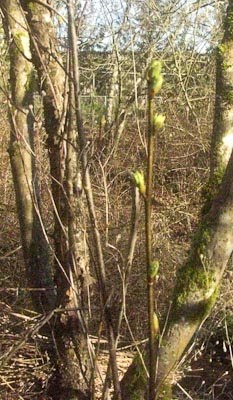
Fat alder buds (Alnus rubra)

As early tree and shrub buds were swelling and opening last week, signs of human habitation suddenly appeared on the west side of North Creek.

Indian plum (Oemleria cerasiformis)--one of the earliest blooming native shrubs

I spotted this mysterious structure on the far side of the foot bridge and crossed over to look more closely.


After I crossed the bridge it became obvious there was more to the lonely structure than what I could see from the other side of the creek.


Soon I spotted another structure with a little pile of firewood in front. (Fire is not allowed on campus, but firewood is essential for authenticity.)


One group constructed a long house of sorts and were inside refining the structure and enjoying each other's company.


This hamlet is the latest incarnation of Creek Village, which for the past four years has arisen and flourished for about a month, in early or late spring.

During the first year, four Clearwater students created homes within the natural structure of shrubs, trees and underbrush across the creek. Matt, the only staff member in the village, acted as lodge keeper. Creek Village residents paid him in salmonberries for the opportunity to sleep at the lodge, located at Second Beach. (There are three accessible beaches along Clearwater School's stretch of North Creek. Starting with the most northern beach, they are consecutively named First, Second and Third Beach.) Every day residents trooped to their village. Someone yelled "Breakfast!"; five minutes later, "Lunch!"; after five more minutes, "Dinner!"; then "Night time!"; and finally, "Morning!". They shared food from their lunches and ate salmonberries at meal time.


A year later the four original village founders were joined by two more people. In addition to the daily schedule, they added picnics at Third Beach and hikes to First Beach, where they foraged and explored. The third year of Creek Village was much the same, with the addition of four more residents.


By most accounts, Creek Village this year is a lot more fun than the previous three years combined. For one thing, around 16 people are involved so far, although they're not always all in residence at the same time. No staff members are regular residents of this year's village. The group abandoned the tree and shrub dwellings from previous years (which they call "Abandoned Creek Village"), although some continue to poke around the old digs in the same manner as anyone who is fascinated by abandoned townsites.


More after the jump...
This year residents scavenged sturdy downed tree branches to shape conical and oblong skeletons, and then covered them with blankets and tarps. Inside the structures residents placed sleeping pads, blankets and lunches. At the end of each day, they leave the building skeletons standing and pack out all the tarps, blankets and pads.


This year villagers divide the day into four segments: breakfast, dinner, night and morning. A day is 30 minutes long. Residents who have cell phones keep track of the time and announce when each segment begins. Residents have created currency to pay for stick weapons and food. Currency is mined in the sandbar at Third Beach, although some people also bring trinkets from home to serve as currency. There is also a lot of item trading.


With the influx of new residents this year, conflict was inevitable. One group of people wanted everyone to have imaginary pets that followed people around, but another group was firmly opposed. One resident described the conflict as a civil war that involved the destruction of some homes and different factions yelling "Pets" or "No pets". Everyone agreed to put the matter to a vote. A majority voted against a requirement that everyone have pets, while allowing people who wanted pets to have them.

Soon after this issue was resolved and homes were restored, residents decided to practice stick fighting for fun and everything was peaceful.


Peace continued even as Outcast Village was created by three students nearby as an alternate place to hang out and to have fun good-naturedly bugging Creek village residents.


A new person joined Creek Village and decided to start his own town near First Beach, which he called Riverside Village. He recruited so many Creek Village residents for his town that half the population left. The remaining Creek Village inhabitants felt abandoned and declared war on Riverside Village. Stick fighting ensued; no one was hurt and no one destroyed people's homes.

By this time, each village had a mayor--Lily for Creek Village and Stephen for Riverside Village. The two mayors met and decided the fighting was pointless. They convinced the residents of each of their villages to stop fighting and everyone agreed to be residents of Creek Village. The town retains the two locations as distinct and cooperative neighborhoods. The two mayors agreed to be co-mayors of greater Creek Village.

The residents of Creek Village last week included Lily, Justin (aka Boombox), Arlo, Nikos, Tommie, Jackie, Vera, Mara, Jesse, Chiara, Zoe, J.R., Jackie, Stephen (aka Crazy Uncle Steve), Tarka and Caden.


End of post.

Tuesday, November 2, 2010

The Complex Story of Salmon in North Creek

This post is a departure from news about daily life at Clearwater and thoughts on Sudbury philosophy and practice. I was inspired by our Clearwater sockeye salmon, returning in much larger numbers this year to spawn in North Creek, to find out more about their story. I turned up information that I found surprising and fascinating. If you'd like to know more, read on.


A few weeks ago, I took a video of some salmon swimming upstream in North Creek on Clearwater's campus.


The Clearwater School is working with Snohomish County Surface Water Management to extensively restore our portion of North Creek to improve salmon habitat for spawning fish, eggs and fry. Thanks to a $75,000 grant, restoration work will begin in earnest next spring.

Around the same time our salmon started returning (descendants of salmon that spawned in 2006), the Seattle Times published an intriguing article . From that article I learned that sockeye that swim from Puget Sound up the fish ladder at Hiram Chittenden locks in Ballard to spawn in the rivers and creeks flowing into Lake Washington are not native to that system. They are descended from sockeye planted from a Skagit River tributary in 1935 and from a temporary hatchery on the Cedar River. North Creek is part of that system, flowing into the Sammamish River, thence to Lake Washington and the ship canal and out to Puget Sound. The Washington Department of Fish and Wildlife website briefly describes how sockeye came to be introduced into the Lake Washington watershed.

The salmon that are native to our rivers and creeks are chinook, coho and kokanee (a freshwater sockeye relative). However, unlike juvenile sockeye that are adapted to spend a year in deep-water lakes before heading to sea, chinook and coho need to mature in rivers and streams. Native salmon species are not doing well at all because our urban lakes and streams are befouled fish habitat. As a population we are not effectively enforcing the laws we created to preserve and restore stream habitat.

More after the jump...

Sockeye survive in larger numbers because they don't need to spend as much time in creeks before heading to sea. They also benefit from being reared in a hatchery. We are all spending $45 million to build a permanent sockeye hatchery on the Cedar River, then tag and track sockeye because of their value as a fishing resource. These non-native fish are not endangered, so there's little incentive or political will to clean up streams and rivers in which they spawn. Despite the fact that we're spending lots of money to preserve a non-native sockeye fishery, the returns have not been good enough most years to even open up fishing, beyond the treaty-guaranteed rights of local tribes.


For a short time, two dead salmon were easily visible near the foot bridge across North Creek. There's no way of knowing whether these two fish completed their mission successfully by laying and fertilizing eggs.

Washington Fish and Wildlife counts the sockeye that return through the Ballard locks each year. The counts since 2000 are available on their website. In 2006 a large number of sockeye returned through the locks--418,015, in fact. In 2007, only 60,117 came back. In 2008 there were 33,6259, and in 2009 only 21,718 returned. On Clearwater's section of North Creek, we did not see any sockeye during the past two years. Despite the fact that we saw more fish in our creek this year, the total return (156,752) was little more than a third of the parent population that spawned the current generation four years ago. Chinook and coho numbers are more dismal--10,565 and 3,608, respectively.


An animal dragged a dead or dying salmon onto the creek bank at school and left a lot of it there. This photo shows the very end of this fish's life cycle. Its flesh has become food for other creatures, including maggots. Little is left but a few thin bones.

There is one more wrinkle to this story, as I know it so far. At least one person knowledgeable about the history and practice of salmon management in the Lake Washington watershed believes that many of the fish spawning in our little local creeks are in fact native endangered kokanee, not introduced sockeye. If that were proven to be the case, it would become necessary for counties and municipalities to enforce stream habitat preservation laws. That is something various public and private interests would find at least inconvenient, and at most extremely expensive.

There is obviously more to this story and more research to be done. We know our current urban living style is not healthy for fish or the wildlife that depend on them. It is easy to feel overwhelmed and discouraged by the scope and complexity of the problem. To solve it requires consistent, informed action and a commitment to live sustainably by us, the inhabitants of the Puget Sound area. Our school's restoration efforts may be small in the scheme of things, but I treasure being part of a school community that is actively working to create better habitat for salmon, other creatures and humans.

End of post.

Thursday, October 7, 2010

Big Kids on the Playground

As promised, here is the second post about the North Creek Park outing during the first week of school. After everyone had explored the boardwalk and other trails in the park, we all gathered at the playground near the wetland. The youngest student in our party was 8 years old and the oldest 18. With the exception of one surprisingly challenging piece of equipment, the playground was a fun diversion. It's always fun to see older Clearwater kids play with abandon and without self-consciousness, especially in a playground built with with much younger children in mind.


A gaggle of girls on a bridge


A big guy can get a big bounce


Cass (on pole) and Braden


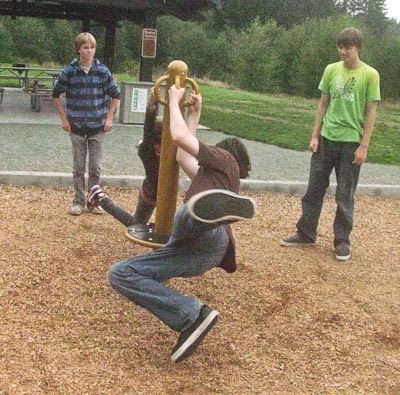
The equipment pictured above was challenging, especially for the oldest, biggest kids, and was the source of much experimentation and discussion. It's a large pole with a platform for sitting or standing that rotates when someone pushes either the person on it or the handles at the top. Unlike a merry-go-round, riders have to be close to the pivot point.


Leo spinning Cass & Keenan


It turned out to be devilishly difficult for big, tall students to even stay on, despite bigger muscles and dogged determination. In addition, several older students looked positively green after just a few seconds spinning. The champion spinner was 10-year-old Keenan, whose pole-spinning enthusiasm and stamina was inexhaustible. She had no trouble hanging on, felt dizzy but never sick, and earned the respect and admiration of the 13- to 18-year-old guys in the group.


Swingers Mara, Matt, Delayney and Leo


Lucas and Cass flying


Older students continued to work at the spinning pole challenge. Some decided that rather than trying to hang on to the pole, they would take advantage of the centrifuge effect. They clung to the handles at the top, ran and launched themselves. For a few thrilling and satisfying seconds, their bodies were airborne.


Not to be outdone and in spite of her awesome ability to hang on to the spinning pivot, 10-year-old Keenan got in on flying, too.


Braden and Keenan


Keenan and Cass (Lucas behind pole)


Airborne trio Lucas, Keenan and Cass


Cass and Aidan


As a staff member, I have the privilege of watching Clearwater students metaphorically spread their wings--maturing, experimenting, developing skills, taking leadership, discovering and pursuing passions, offering empathy and compassion, to name a few examples. How exhilarating it felt that day at the park to watch the physical embodiment of the very real and important flights that Clearwater students take every day as they figure out what's important to them, develop relationships, and work hard to achieve their goals.

End of post.

Monday, September 27, 2010

North Creek Park Outing

Last week a group of us piled into the Clearwater bus and drove up to North Creek Park. If you live in the area and haven't visited this park, it's well worth a trip. It's a wetland with a boardwalk through it, lots of wildlife and interpretive signs. The flora and fauna vary with the seasons and different wildlife are visible at different times of day.

The day we were there was warm. Although the weather was dry, there are several areas of the board walk that are prone to sink slightly below water level when a bunch of people walk along them at the same time. That was a source of amusement and challenge for several Clearwater students, who wanted all of us to walk or stand on a section, submerging it so they could have the fun of escaping the deluge or wading in it.

Heading down to the boardwalk


One interpretive sign talked about the importance of wetlands, describing them metaphorically as the kidneys of the earth. Clearwater staff member Matt thought it would be fun to talk about his own kidneys as the wetlands of the body. A little later, a student extended the metaphor further and suggested that lakes might be the bladders of the earth.

Reading about the function of wetlands


Delicate floating duckweed


Girls returning from a boardwalk spur to a peat bog


Because wetlands help clean storm water, the fact that Clearwater is downstream of North Creek Park means that the creek is cleaner when it gets to us than before it goes through the park. In fact, we noticed areas of water in the park that had an oily sheen and the appearance of sludge.

We also noticed and heard lots of birds and insects, and saw the occasional garter snake.


Fun with flooded boardwalk


Girls voluntarily trapping themselves on platform


Common Touch-Me-Not or Jewelweed (Impatiens noli-tangere)


Water Smartweed (Polygonum amphibium)


A lovely nosegay made by a student

In spite of one minor injury (a nettle sting), everyone spent a lot of time exploring the board walk and dirt trails of the park. After exploring the wetland, we all met up at the playground by the parking lot, where everyone played. Photos and information about that part of the trip will be in a post later this week.

End of post.

Thursday, February 4, 2010

Soccer at the Field

Here are a LOT of soccer pictures from a December day at Mill Creek Sports Park. Note the variety of ages and sizes. On this particular day a couple of Clearwater alumni who happened to be visiting the school joined the regulars to play soccer. (Shameless plug for donations for a new bus: We need the bus to take this many players to the field.)

In addition to playing games, many Clearwater players also run practice drills to improve their skills. Since everyone began playing several times a week a few months ago everyone's individual skill and ability to execute strategic plays as a team has improved markedly.

The little five-year-old girl in the foreground of the first photo really wanted to play, but she is so tiny and has never played soccer so everyone was afraid she'd get hurt in a rough and tumble, high-energy game. Instead, while everyone else was playing she and I kicked the a ball back and forth and teamed up to kick it all the way around the entire sports park twice. She also got to practice a little goal kicking with everyone after the game was over.

It was heartwarming and wonderful to watch eight- and ten-year-old goalies make a great show of leaping to block her ball and miss so that she made her goal every time. No one suggested that they do that. They instinctively understood what would please her and generously included her and ensured her success.


An eight- and nineteen-year-old going toe to toe.


Lots more photos after the jump!


The symetry of the players in this photo is lovely.


Matt leads the charge.


Valiant and failed attempt to block a goal.


Goal-kicking practice. Impressive form, Stephanie!


I took a bunch of pictures trying to get this goalie in action. He is poetry in motion!


This photo is grainy and the lens isn't aimed quite high enough, but here he is in mid-leap.


End of post.