by Matt Garrity, staff member
Gregory demonstrates how to build a really tall tower during Clearwater's Play Group program. The part time program is designed for younger students and is a great introduction into the school environment.
Showing posts with label age mixing. Show all posts
Monday, March 11, 2013
Sunday, January 13, 2013
Not as different as I thought (Part II)
by Susan Milton, Clearwater parent
Part I was published last week.
As I was writing about some of the similarities between my own school experience growing up, and my kids' experience at Clearwater, I started to think about how both schools were opened in order to provide the community with an educational option that at the time was available at only a handful of schools around the country.
Here is what The Bryn Mawr School website says about the founding of the school in 1885:
".... putting the social standing and reputation of their families in Baltimore at risk, ... five young women chose to open a school that would prepare local girls for something they knew many families did not yet want - intellectual challenge on par with that available to boys." "The curriculum was daring and liberal for its time, including both modern and classical languages, English, history, math, the latest scientific theories, and a focus on physical education - all of which stretched the limits of imagination and acceptance."
Today, it is really hard to wrap our heads around the mindset of a time decades before women would have the right to vote in this country, when it was highly controversial for girls to go to school and take classes in English, Math, P.E. and so on. But, as a Clearwater parent, I am very familiar with the experience of sending my kids to a school which stretches "the limits of imagination and acceptance."
I'm not sure exactly what motivated parents in 1885 to send their daughters to a school where girls were viewed as equal to boys. Maybe their reasons were not so different from the reasons parents today send their kids to Clearwater, where children have rights and responsibilities that throughout most of our culture are only enjoyed by adults.
Many of the mothers of those first Bryn Mawr students must have wished that they could have gone to a similar school when they were young. Perhaps some families were seeking a solution for a "difficult" daughter who just could not seem to succeed at what the "normal" girls of the day were doing. There must have been families in which one parent approved of the school and one didn't. In any case, it took courage for all of the parents to allow their daughters a type of education which many people felt would be destructive to the girls' futures, and perhaps even to the future of society as a whole.
It so happened that I was in the 100th class to graduate from The Bryn Mawr School for Girls, and so there was some extra focus on the history of our school that year. I vaguely remember that Founders Day was kind of a big deal. To me, the founders were those stern-looking women in Victorian outfits in those old photographs, and I couldn't really imagine them as actual people. Now that I am more aware of the challenges involved in the early days of an innovative style of school, they seem more real to me, and I am impressed and inspired by what they were able to accomplish. I picture them as free-thinking, visionary, and determined women, not so unlike our own Clearwater founders.
I am sure that the early supporters of The Bryn Mawr School would be happy to see how it all turned out. They were correct in anticipating the type of world that women of the future would be living in, and they also helped to bring that world into being. And the school continued to thrive and grow for the next century and well beyond that.
It's fun for me to think about Clearwater celebrating its 100th year in 2096. Perhaps some of today's students will be around to tell their stories. Maybe by then, it will be entirely commonplace for kids to vote on issues important to them, and to learn what they want to, when they want to.
Part I was published last week.
As I was writing about some of the similarities between my own school experience growing up, and my kids' experience at Clearwater, I started to think about how both schools were opened in order to provide the community with an educational option that at the time was available at only a handful of schools around the country.
Here is what The Bryn Mawr School website says about the founding of the school in 1885:
".... putting the social standing and reputation of their families in Baltimore at risk, ... five young women chose to open a school that would prepare local girls for something they knew many families did not yet want - intellectual challenge on par with that available to boys." "The curriculum was daring and liberal for its time, including both modern and classical languages, English, history, math, the latest scientific theories, and a focus on physical education - all of which stretched the limits of imagination and acceptance."
Founders of Bryn Mawr School for Girls
Today, it is really hard to wrap our heads around the mindset of a time decades before women would have the right to vote in this country, when it was highly controversial for girls to go to school and take classes in English, Math, P.E. and so on. But, as a Clearwater parent, I am very familiar with the experience of sending my kids to a school which stretches "the limits of imagination and acceptance."
I'm not sure exactly what motivated parents in 1885 to send their daughters to a school where girls were viewed as equal to boys. Maybe their reasons were not so different from the reasons parents today send their kids to Clearwater, where children have rights and responsibilities that throughout most of our culture are only enjoyed by adults.
Many of the mothers of those first Bryn Mawr students must have wished that they could have gone to a similar school when they were young. Perhaps some families were seeking a solution for a "difficult" daughter who just could not seem to succeed at what the "normal" girls of the day were doing. There must have been families in which one parent approved of the school and one didn't. In any case, it took courage for all of the parents to allow their daughters a type of education which many people felt would be destructive to the girls' futures, and perhaps even to the future of society as a whole.
Clearwater students
It so happened that I was in the 100th class to graduate from The Bryn Mawr School for Girls, and so there was some extra focus on the history of our school that year. I vaguely remember that Founders Day was kind of a big deal. To me, the founders were those stern-looking women in Victorian outfits in those old photographs, and I couldn't really imagine them as actual people. Now that I am more aware of the challenges involved in the early days of an innovative style of school, they seem more real to me, and I am impressed and inspired by what they were able to accomplish. I picture them as free-thinking, visionary, and determined women, not so unlike our own Clearwater founders.
Girls and ponies at Clearwater
I am sure that the early supporters of The Bryn Mawr School would be happy to see how it all turned out. They were correct in anticipating the type of world that women of the future would be living in, and they also helped to bring that world into being. And the school continued to thrive and grow for the next century and well beyond that.
Martha Carey Thomas, a founder of Bryn Mawr School for Girls
It's fun for me to think about Clearwater celebrating its 100th year in 2096. Perhaps some of today's students will be around to tell their stories. Maybe by then, it will be entirely commonplace for kids to vote on issues important to them, and to learn what they want to, when they want to.
Thursday, January 3, 2013
Not As Different As I Thought (Part I)
by Susan Milton, Clearwater parent
One day a couple of years ago, I was at a playground chatting about schools with another mom while our kids played. After hearing a bit about The Clearwater School, where my kids go, and The Bryn Mawr School for Girls, where I went as a child, she said, "Oh, so you wanted your kids to have the kind of school that you had". I started to say, "oh, no, no,...", when all of the sudden I realized that she had a point. In mid-sentence, I changed my mind 180 degrees and said, "Yeah, I guess you're right. I never thought of it like that."
I realized in that moment that although my own school was very traditional, and all girls, and we wore uniforms (although it was not a religious school), and Clearwater is nothing like this, that maybe both schools are similar in the ways that turned out to be of lasting importance to me.
For example:
Part 2 will be published next week.
Susan Milton has two children at The Clearwater School: Thad (14) and Imogen (7), both of whom have attended since they started school at age four and five.
One day a couple of years ago, I was at a playground chatting about schools with another mom while our kids played. After hearing a bit about The Clearwater School, where my kids go, and The Bryn Mawr School for Girls, where I went as a child, she said, "Oh, so you wanted your kids to have the kind of school that you had". I started to say, "oh, no, no,...", when all of the sudden I realized that she had a point. In mid-sentence, I changed my mind 180 degrees and said, "Yeah, I guess you're right. I never thought of it like that."
Susan, 2nd row, 2nd from left
I realized in that moment that although my own school was very traditional, and all girls, and we wore uniforms (although it was not a religious school), and Clearwater is nothing like this, that maybe both schools are similar in the ways that turned out to be of lasting importance to me.
For example:
- Small Supportive Community. At my school, there were about 50 girls in each grade. Many, including me, went to the school from kindergarten or first grade through the end of high school. And while I wouldn't exactly say that I had warm fuzzy feelings towards everyone at every moment, it was a culture where kindness and basic human decency were valued highly. I never experienced or witnessed any bullying at school.
- Continuity. I got to see how different people grew and changed over the years, and I remember times when teachers who knew me as a little girl were still there encouraging me as a teenager. It is not so hard for me to imagine how my kids feel at Clearwater, where they know everyone and can stay in the same school from early childhood through early adulthood. I am really glad that this experience is available to them.
- Beautiful, Healthful Surroundings.That concrete, fenced-in school building is so ubiquitous, that it seems like it somehow must be a normal, natural place for children to spend their days. But whenever I visit a school like this I never feel like I want to stay long in that institutional space, no matter how nice the people are. I was lucky enough to spend my school years surrounded by grass, trees, and homelike buildings with plenty of fresh air. This wasn't the kind of thing I remember giving a lot of thought to as a kid, but looking back on it, I feel that this calming environment sunk in deep and had a great effect on my overall well-being, including my ability to learn while at school. And I am really glad that at Clearwater my kids are surrounded by natural beauty and comfortable indoor spaces every day.
- Outstanding Learning Environment. Education was a huge priority for my parents, and they agonized over the decision about what type of school would be best for me. Like every parent I know, they wanted me to be successful in life and they also thought that there was intrinsic value in being an educated person. I believe that the school I went to turned out to be an amazing place for learning, and that Clearwater offers all the best aspects of that, plus lots more. It is really easy for me to focus on the new and different aspects of Clearwater's approach to learning, because I feel so passionately that these differences can offer a way out of so many of the problems that exist in education. But now I am thinking that maybe it is the similarities that drew me in as much as the differences, and that I am able to recognize what a fantastic environment for learning Clearwater is because of the way it builds upon what I experienced myself growing up.
Part 2 will be published next week.
Susan Milton has two children at The Clearwater School: Thad (14) and Imogen (7), both of whom have attended since they started school at age four and five.
Saturday, December 8, 2012
Learning not to bust
By Bryan
A game that's been making the rounds at school for the past week is Chinese Poker. I play a lot of card games with students at school, but I came to this one a little bit late. Gregory was the first student to teach me.
Each player is dealt thirteen cards, all face-up (five cards to start with, then eight more one at a time) with which to make three poker hands (two of five cards and one of three). Once you have put a card into one of the hands, it cannot move. Each of your hands competes against the corresponding hand of your opponent, so it's possible to win once, twice, or three times per round. But the hands have to be stacked with the highest-scoring hand at bottom and the lowest one on top; otherwise, you bust, and lose points instead. While Gregory was teaching me, I lost.
As with most games, the rules sound more complicated than the play actually turns out to be. In fact, playing the game is fairly simple, but the strategy of the game takes a little practice to learn; you are looking at all the cards out on the table and you have to figure the odds fairly quickly of getting the cards you want. The day after I learned it, I joined a game that had been ongoing for most of the day with a rotating cast of players. I stayed for a couple of hours until I gave up. I had busted every round but one.
Fortunately, Gabriel, who had been playing most of the game, took me under his tutelage. "No one at that table was playing sanely except Maddy and me," he told me. "Everyone was being way too aggressive." Since he and Maddy were the second- and first-place winners, respectively, I figured he was right; besides, he plays so many games and thinks about strategy so much, he probably was seeing things about the play I hadn't even considered. He and I sat down to practice. He patiently walked me through the game-play and coached me as I tried to reign in my flailing strategy. The first round went pretty slowly, but by the end of our 45-minute lesson I hadn't busted once.
As I thought about it later, I realized that I can remember only once been taught a game by a student during the ten-plus years I worked in a public school. They were always playing -- computer games, board games, make-believe games, playground games -- but although I looked over their shoulders regularly and joined in often enough, I never really undertook to learn from them. As far as I know, it never occurred to them that they could teach me, either; but then, I didn't ask; and my guess is they didn't think they had permission to offer. I can't help but wonder what I might have done to make it clear they could have.
This question just doesn't arise at Clearwater, and it's not because of anything I do. From Clearwater students, I have learned Magic the Gathering, Line Ball, and quite a number of computer games (not always very well). Admittedly, I live with one of these students, but I don't think that's the main difference.
I'm looking forward to the next game of Chinese Poker. I think I stand a good chance of not coming in last.
Sunday, November 18, 2012
Learning Music at The Clearwater School
Cass
Singing, playing instruments and listening to and talking about music have been a big part of people's lives at Clearwater for many years. A changing group of girls have been members of a small choir for several years. A few students have become proficient at guitar or drums. A few poke around on the piano or take a few lessons.
Maddy and Jacy
This year, enough people are interested in learning to play guitar and drums that staff member and musician Matt Garrity has set aside two mornings a week for scheduled lessons. Four girls are learning to play the guitar and, in addition to their weekly lessons, spend time practicing on their own and learning to play guitar and sing at the same time.
Cass, Matt and Leo
Two teenage boys spend hours each week with each other, alone or with Matt on drums, playing electric guitar and bass. A couple of girls are writing original songs with music and lyrics, consulting with Matt. There have been some piano lessons this year, too.
Guitar lesson with Matt
Some of the girls who are in the choir are also taking guitar and piano lessons. What they are learning about playing instruments adds to their understanding of how music works and deepens their singing skills.
Aidan and Matt
It is rare for the music room to be empty for extended periods. Usually, someone is taking a lesson, practicing in a group or alone, or jamming.
Watch this video sample of some of the music making at Clearwater over the past several weeks. The video shows people not performing, but practicing--working to get better at playing an instrument, to create rhythm, melody and harmony, to compose a song which was later discarded, to play the same chord progression or improvise something new together, and to help each other increase their skills.
Monday, October 29, 2012
Clearwater Hosts Weekly Play Days
The Clearwater School's Play Days program provides an opportunity for toddlers, preschoolers and their families to experience our ground breaking model of education. Join us for open-ended play and parent education every Friday, from 9:30am to 12noon. No reservations are required and the program is free.
At The Clearwater School learning happens through active exploration. Play Days allow young children to freely explore a safe environment. By following their own impulses, they can totally be themselves as they grow and develop friendships with others.
Each Friday we include a discussion time so parents can learn the underlying philosophy and practice of Clearwater's approach and gain parenting support.
A highlight of our program is the involvement of Clearwater students and many opportunities for visiting children to observe and interact with them. For families considering future enrollment in our school, Play Days is an opportunity interact with older students and observe their well-honed decision-making and problem-solving skills. Twelve students signed up to host, provide information and play with visiting children and their parents. They will alternate with each other every week so everyone can be a part of the program.
When asked what attracted them to participate in Play Days, students had this to say.
Thirteen-year-old Maddy said she likes building relationships with kids and parents. She thinks it's easier for parents to enroll their children at Clearwater when they know people here. Eleven-year-old Nikos said he likes playing with younger kids.
Thirteen-year-old Alise loves kids and knows being part of Play Days will be a fun experience. Fifteen-year-old Gregory enjoys small children and said he learns how to be a better person by being with young children. Thirteen-year-old Michael loves reading to and teaching kids stuff. He also likes watching kids grow up.
Twelve-year-old Lily believes having this program will help the school grow, something that is important to her. Matt, the staff member coordinating this program, said students who participate in Play Days are taking leadership roles and giving back to the school.
If you are interested in attending, there's no need to call ahead--just show up at 9:30am any Friday morning. (NOTE: Because of Clearwater's holiday schedule, there won't be Play Days on November 23, December 21 and 28.)
At The Clearwater School learning happens through active exploration. Play Days allow young children to freely explore a safe environment. By following their own impulses, they can totally be themselves as they grow and develop friendships with others.
Each Friday we include a discussion time so parents can learn the underlying philosophy and practice of Clearwater's approach and gain parenting support.
Students meet with staff to organize Play Days
A highlight of our program is the involvement of Clearwater students and many opportunities for visiting children to observe and interact with them. For families considering future enrollment in our school, Play Days is an opportunity interact with older students and observe their well-honed decision-making and problem-solving skills. Twelve students signed up to host, provide information and play with visiting children and their parents. They will alternate with each other every week so everyone can be a part of the program.
When asked what attracted them to participate in Play Days, students had this to say.
Thirteen-year-old Maddy said she likes building relationships with kids and parents. She thinks it's easier for parents to enroll their children at Clearwater when they know people here. Eleven-year-old Nikos said he likes playing with younger kids.
Thirteen-year-old Alise loves kids and knows being part of Play Days will be a fun experience. Fifteen-year-old Gregory enjoys small children and said he learns how to be a better person by being with young children. Thirteen-year-old Michael loves reading to and teaching kids stuff. He also likes watching kids grow up.
Twelve-year-old Lily believes having this program will help the school grow, something that is important to her. Matt, the staff member coordinating this program, said students who participate in Play Days are taking leadership roles and giving back to the school.
Play Days organizing meeting
If you are interested in attending, there's no need to call ahead--just show up at 9:30am any Friday morning. (NOTE: Because of Clearwater's holiday schedule, there won't be Play Days on November 23, December 21 and 28.)
Friday, February 25, 2011
Creek Village Rises Again
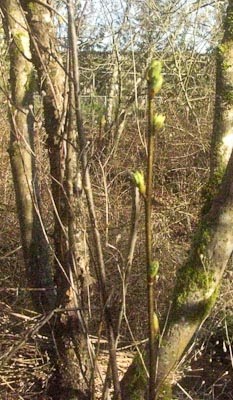
Fat alder buds (Alnus rubra)
As early tree and shrub buds were swelling and opening last week, signs of human habitation suddenly appeared on the west side of North Creek.
Indian plum (Oemleria cerasiformis)--one of the earliest blooming native shrubs
I spotted this mysterious structure on the far side of the foot bridge and crossed over to look more closely.

After I crossed the bridge it became obvious there was more to the lonely structure than what I could see from the other side of the creek.

Soon I spotted another structure with a little pile of firewood in front. (Fire is not allowed on campus, but firewood is essential for authenticity.)

One group constructed a long house of sorts and were inside refining the structure and enjoying each other's company.

This hamlet is the latest incarnation of Creek Village, which for the past four years has arisen and flourished for about a month, in early or late spring.
During the first year, four Clearwater students created homes within the natural structure of shrubs, trees and underbrush across the creek. Matt, the only staff member in the village, acted as lodge keeper. Creek Village residents paid him in salmonberries for the opportunity to sleep at the lodge, located at Second Beach. (There are three accessible beaches along Clearwater School's stretch of North Creek. Starting with the most northern beach, they are consecutively named First, Second and Third Beach.) Every day residents trooped to their village. Someone yelled "Breakfast!"; five minutes later, "Lunch!"; after five more minutes, "Dinner!"; then "Night time!"; and finally, "Morning!". They shared food from their lunches and ate salmonberries at meal time.

A year later the four original village founders were joined by two more people. In addition to the daily schedule, they added picnics at Third Beach and hikes to First Beach, where they foraged and explored. The third year of Creek Village was much the same, with the addition of four more residents.

By most accounts, Creek Village this year is a lot more fun than the previous three years combined. For one thing, around 16 people are involved so far, although they're not always all in residence at the same time. No staff members are regular residents of this year's village. The group abandoned the tree and shrub dwellings from previous years (which they call "Abandoned Creek Village"), although some continue to poke around the old digs in the same manner as anyone who is fascinated by abandoned townsites.

More after the jump...
This year residents scavenged sturdy downed tree branches to shape conical and oblong skeletons, and then covered them with blankets and tarps. Inside the structures residents placed sleeping pads, blankets and lunches. At the end of each day, they leave the building skeletons standing and pack out all the tarps, blankets and pads.

This year villagers divide the day into four segments: breakfast, dinner, night and morning. A day is 30 minutes long. Residents who have cell phones keep track of the time and announce when each segment begins. Residents have created currency to pay for stick weapons and food. Currency is mined in the sandbar at Third Beach, although some people also bring trinkets from home to serve as currency. There is also a lot of item trading.

With the influx of new residents this year, conflict was inevitable. One group of people wanted everyone to have imaginary pets that followed people around, but another group was firmly opposed. One resident described the conflict as a civil war that involved the destruction of some homes and different factions yelling "Pets" or "No pets". Everyone agreed to put the matter to a vote. A majority voted against a requirement that everyone have pets, while allowing people who wanted pets to have them.
Soon after this issue was resolved and homes were restored, residents decided to practice stick fighting for fun and everything was peaceful.

Peace continued even as Outcast Village was created by three students nearby as an alternate place to hang out and to have fun good-naturedly bugging Creek village residents.

A new person joined Creek Village and decided to start his own town near First Beach, which he called Riverside Village. He recruited so many Creek Village residents for his town that half the population left. The remaining Creek Village inhabitants felt abandoned and declared war on Riverside Village. Stick fighting ensued; no one was hurt and no one destroyed people's homes.
By this time, each village had a mayor--Lily for Creek Village and Stephen for Riverside Village. The two mayors met and decided the fighting was pointless. They convinced the residents of each of their villages to stop fighting and everyone agreed to be residents of Creek Village. The town retains the two locations as distinct and cooperative neighborhoods. The two mayors agreed to be co-mayors of greater Creek Village.
The residents of Creek Village last week included Lily, Justin (aka Boombox), Arlo, Nikos, Tommie, Jackie, Vera, Mara, Jesse, Chiara, Zoe, J.R., Jackie, Stephen (aka Crazy Uncle Steve), Tarka and Caden.

End of post.
Labels:
age mixing,
creativity,
exercise,
North Creek,
Outside,
Play
Friday, January 7, 2011
Hanging Out in the Kitchen
It's not all cooking in the kitchen. When the Cooking Class isn't whipping stuff up, the kitchen is a very popular hangout.
![]() |
| Pizza sales have been moved to the Conference Room. |
![]() |
| A rare large group meal for Pizza Day. |
![]() |
| One of the large tables often has Magic or another multiplayer game going. |
![]() |
| A bidding game is a favorite right now. |
![]() |
| One of our youngest students enjoys a candy necklace a friend shared with her. |
Tuesday, October 12, 2010
Tuesday Cooking Class
Each Tuesday at Clearwater staff member Mat Riggle and Robert, an advanced student chef, work with Clearwater students of all ages to prepare a meal that the group has chosen. When the food is finished cooking, they all sit down and literally enjoy the fruits of their labors. After eating, everyone works to clean the kitchen, from dishes to pots to counters and tables to the floor.
Recently, they decided to make yakisoba or Japanese fried noodles.


These two peeled carrots.

Robert (below right) noticed that Jaime was peeling the carrot by moving the peeler blade toward his carrot-holding hand rather than away from it. He quickly came over to explain and demonstrate to Jaime the safe way to peel a carrot.

Mat brought a propane wok to school to stir fry the yakisoba. Propane cooks at higher heat than non-commercial stoves. High-heat stir-frying maintains the color and crispness of vegetables better than steaming, which is what lower-heat residential stoves do.

More story, photos and recipes after the jump...
Several students tried their hand at rapidly circulating the meat, veggies and noodles in the wok.


Mat explained that since meat takes longer to cook, it is fried first. He also mentioned that frying with peanut oil adds a distinctive flavor to yakisoba.


Students discovered that keeping the food moving in the wok kept it from sticking or burning. Stirring food up the sides helped the liquid evaporate more quickly and prevented vegetables from steam cooking and becoming mushy.


Various seasonings were added throughout the stir frying to enhance flavors.


Recipes
Pork Yakisoba
12 oz. yakisoba (rinsed with water and drained)
3 cloves garlic (finely chopped)
2 oz. pork (cut into small pieces and marinated with some soy sauce)
2 oz. cabbage (roughly chopped into pieces)
2 oz. carrot (cut into thin strips)
Some scallions (cut into thin threads)
2 Tbsp oil
2 Tbsp soy sauce
1 Tbsp sake
1/2 tsp mirin
3 dashes white pepper powder
1/2 tsp sugar
1/8 tsp sesame oil
Salt to taste
Heat up wok with oil. Add garlic and stir fry unti llight brown in color. Add pork and do a few quick stirs before adding cabbage and carrot. Stir a few times and add noodles and all the seasonings. Continue to stir-fry until the vegetables and noodles are cooked, for 1-2 minutes. Transfer out and serve immediately with some benishoga (Japanese pickled ginger).
Chicken Yakisoba
1/2 tsp sesame oil
1 Tbsp canola oil
2 Tbsp chile paste
2 cloves garlic, chopped
4 skinless, boneless chicken breast halves, cut into 1-inch cubes.
1/2 cup soy sauce
1 onion, sliced lengthwise into eighths
1/2 medium head cabbage, coarsely chopped
2 carrots, coarsely chopped
8 oz. soba noodles, cooked and drained
In a large skillet combine sesame oil, canola oil and chile paste. Stir fry 30 seconds. Add garlic and stir fry an additional 30 seconds. Add chicken and 1/4 cup of soy sauce and stir fry until chicken is no longer pink. Remove mixture from pan, set aside and keep warm.
In the emptied pan, combine onion, cabbage and carrots. Stir fry until cabbage begins to wilt. Stir in the remaining soy sauce, cooked noodles and the chicken mixture to pan and mix to blend. Serve and enjoy!
End of post.
Recently, they decided to make yakisoba or Japanese fried noodles.
Setting up
Separating yakisoba noodles
Cutting chicken
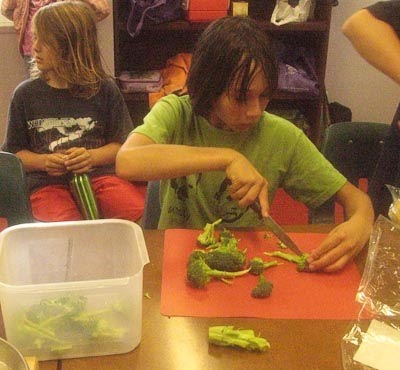
Several students chopped vegetables.


These two peeled carrots.

Robert (below right) noticed that Jaime was peeling the carrot by moving the peeler blade toward his carrot-holding hand rather than away from it. He quickly came over to explain and demonstrate to Jaime the safe way to peel a carrot.

Mat brought a propane wok to school to stir fry the yakisoba. Propane cooks at higher heat than non-commercial stoves. High-heat stir-frying maintains the color and crispness of vegetables better than steaming, which is what lower-heat residential stoves do.

More story, photos and recipes after the jump...
Several students tried their hand at rapidly circulating the meat, veggies and noodles in the wok.


Mat explained that since meat takes longer to cook, it is fried first. He also mentioned that frying with peanut oil adds a distinctive flavor to yakisoba.


Students discovered that keeping the food moving in the wok kept it from sticking or burning. Stirring food up the sides helped the liquid evaporate more quickly and prevented vegetables from steam cooking and becoming mushy.


Various seasonings were added throughout the stir frying to enhance flavors.


Recipes
Pork Yakisoba
12 oz. yakisoba (rinsed with water and drained)
3 cloves garlic (finely chopped)
2 oz. pork (cut into small pieces and marinated with some soy sauce)
2 oz. cabbage (roughly chopped into pieces)
2 oz. carrot (cut into thin strips)
Some scallions (cut into thin threads)
2 Tbsp oil
2 Tbsp soy sauce
1 Tbsp sake
1/2 tsp mirin
3 dashes white pepper powder
1/2 tsp sugar
1/8 tsp sesame oil
Salt to taste
Heat up wok with oil. Add garlic and stir fry unti llight brown in color. Add pork and do a few quick stirs before adding cabbage and carrot. Stir a few times and add noodles and all the seasonings. Continue to stir-fry until the vegetables and noodles are cooked, for 1-2 minutes. Transfer out and serve immediately with some benishoga (Japanese pickled ginger).
Chicken Yakisoba
1/2 tsp sesame oil
1 Tbsp canola oil
2 Tbsp chile paste
2 cloves garlic, chopped
4 skinless, boneless chicken breast halves, cut into 1-inch cubes.
1/2 cup soy sauce
1 onion, sliced lengthwise into eighths
1/2 medium head cabbage, coarsely chopped
2 carrots, coarsely chopped
8 oz. soba noodles, cooked and drained
In a large skillet combine sesame oil, canola oil and chile paste. Stir fry 30 seconds. Add garlic and stir fry an additional 30 seconds. Add chicken and 1/4 cup of soy sauce and stir fry until chicken is no longer pink. Remove mixture from pan, set aside and keep warm.
In the emptied pan, combine onion, cabbage and carrots. Stir fry until cabbage begins to wilt. Stir in the remaining soy sauce, cooked noodles and the chicken mixture to pan and mix to blend. Serve and enjoy!
End of post.
Subscribe to:
Posts (Atom)